

You know what personal data you hold, why, and until when — and you can prove what you destroyed
Business Plus Privacy adds the compliance layer on top of your document register: processing purposes, consents and their expiry, data subject requests, legal hold on a document and controlled destruction, with an access log and a destruction log.
Part of the Business Plus package.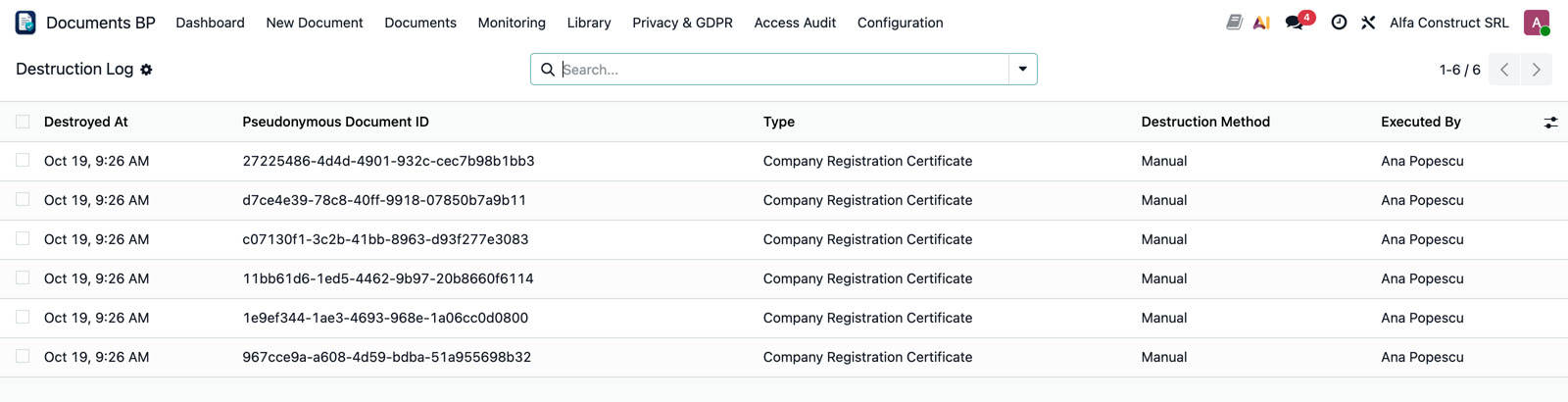
Processing purposes
The lawful basis for keeping each data category, defined once and applied to your document types.
Consents with an expiry date
The consents you received, with their validity; expiry is tracked automatically instead of being remembered by someone.
Data subject requests
Access, rectification, erasure — logged, numbered and carried through to the end, with a deadline.
Legal hold
A document under litigation cannot be destroyed, and the reason for the hold must be written down.
Destruction you can prove
A destruction log: what was destroyed, who approved it and when — even after the file itself is gone.
Access log
Who opened a document holding personal data, and when.
- Turns your privacy policy into rules that are enforced, not a document on the intranet
- Reduces the risk of destroying something you were obliged to keep
- Shortens the answer to a data subject request, from a search to a list
- Leaves the evidence where the act happened — an access log and a destruction log
- Keeps compliance in the same system as the documents, not in a parallel register
You know what personal data you hold, why, and until when — and you can prove what you destroyed.
Tell us how you work and we will show you the app on your own example, right inside Odoo.
Is it a separate program from Odoo?
No. Business Plus GDPR is a set of Odoo apps: you work in the same Odoo, with the same menus, users and rights.